3 – Innovative Schools (*)

1. Linking with the Previous Article

In the previous article (“Change, Innovation and the School”) it was argued that:

  1. Innovation involves change, but not every change brings innovation;
  2. Change can be ordinary (within the paradigm) or extraordinary (disruptive of the paradigm);
  3. Ordinary change is usually small, piecemeal, incremental, gradual, does not depart much from established thought or practice, and so leads at best to the improvement or reformation of an established paradigm; extraordinary change, on the other hand, is usually broad, deep, systemic (holistic), radical, departs considerably from established thought or practice, and so normally leads to the replacement or transformation of an established paradigm;
  4. It is the degree of innovation present in it (i.e., of that which, in it, is distinctly new) that differentiates extraordinary change from ordinary change;
  5. The amount, direction, rhythm and nature of the change that took place in the world in the past sixty five years or so are such as to require transformative change of every institution of society, including the school;
  6. The school, however, has been quite impervious and resistant to this requirement;
  7. Given the penetration of the conventional school in the social fabric, and given the strength of its attachment to the industrial paradigm, its reinvention in the direction of the paradigm outlined in the first article (Ubiquitous Education, or Society as the Learning Environment par excellence) will need to go through a transitional phase in which an Innovative School will help create the Learning Society (Society that Learns and where one Learns) and prepare us to actively, interactively and collaboratively learn in it.

The last article finished with a description of the main features of the Factory-Style School. This article will seek to describe the contours of the Innovative School, which will help pave the way for a world in which every institution of society will be educational (i.e., learning-oriented).

2. The Innovative School: Vision

To be innovative, a school must have a new vision, which includes a new understanding of its nature, mission, and values, as well as of the outcomes it seeks to achieve:

  1. Its nature must be inclusive: given the undeniable fact that we, humans, have multiple dimensions, and that other institutions of society are not presently capable of fully performing their educational tasks, the school needs to focus its attention on all of the dimensions of its students and help each of them develop as fully as possible as an integral and integrated human being;
  2. Its mission must be to create a learning environment where personalized education is possible and viable: given the undeniable fact that we, humans, are all different from one another in our personal characteristics, interests, talents, levels of motivation and learning styles, the school needs to pay special attention to each student in his specific uniqueness and make sure that he learns what he needs and wants to learn in the way and the rhythm in which he learns best;
  3. Its values must be:
    • recognition of the fact that each student is a unique human being, worthy of full respect in his uniqueness by all those who work in the school;
    • recognition of the fact that human beings develop through learning, that is, by building their capacity to do things which they were not capable of doing before;
    • recognition of the fact that human beings learn best when they are actively engaged in doing things that are interesting to them (interest-based active learning, or learning by doing), in collaboration with partners who have similar interests (collaborative projects), and with the support of persons who can, when necessary, mediate the process and facilitate their learning;
    • recognition of the fact that freedom is essential to the learning process, not only in the choice, by the students, of what to learn and of how to do it, but also in the organization of activities, by the school, in such a way as to provide unstructured time for leisure and otioseness (or idleness) on the part of the students (since intelligence does not prosper without a modicum of idleness and creativity does not prosper without a modicum of indiscipline);
    • recognition of the fact that participation, by the students, in the elaboration of rules and in the making of decisions that affect their lives (including the processes in which they are evaluated) is essential for their learning and development.
  4. The Outcomes that it ought to pursue are:
    • help the students define and choose a life project that combines their talents and their passions;
    • help the students determine which competencies, skills, attitudes and values are required to transform their life project into reality and help them build, master or acquire them;
    • maintain in the school a learning environment that is conducive to integral and integrated human development.

3. The Innovative School: Organizing Principles

To be innovative, a school must be built and function according to sound principles, such as these:

  1. To be innovative the school must contemplate broad and general learning expectations for the students (“curriculum“), personalizable for each student and flexible enough to be adjusted as the student develops, possibly changes interests, and defines and redefines his life project;
  2. To be innovative the school must adopt a flexible, student-centered learning methodology that is active, collaborative, problem-oriented, project-based and research-focused;
  3. To be innovative the school must make available to the students rich and abundant educational resources, including different types of digital technology, books, musical instruments, art material and material for art work, tools of various sorts, destined to all kinds of work, including manual labor, such as carpentry, woodwork, electronic / electric / automotive equipment repair, cooking, baking, restaurant and hotel work, etc.), and must allow these resources, and other resources that the students bring with them to the school (such as computers, tablets, smart phones, etc.) to be freely used by the students in their learning process;
  4. To be innovative the school must consider evaluation an essential part of the learning process, which cannot be dissociated from it, since evaluation is not a set of specific procedures applied at the end of the learning process to assess whether, or to what extent, the student learned what was expected of him;
  5. To be innovative the school must have a novel and modern modular architecture, and its spaces must be both generic and specialized but, in either case, flexible, modularizable, and reconfigurable, and its technology infrastructure must be state of the art;
  6. To be innovative the school must have a novel approach to time: time needs to regarded as something to be used flexibly. Business already adopts “flextime“: it is time the school does the same.

4. The Innovative School: Personnel

  1. To be innovative the school must have diverse personnel: professionals who have multiple talents and competencies to perform the general and specialized functions that are needed to address students with diversified and often rather special educational needs;
  2. To be innovative the school must count upon personnel committed to its vision of education and who are passionate for the work they do;
  3. To be innovative the school must select and recruit personnel who are not afraid to change and who want and feel comfortable to work in an student-centered innovative school that favors student initiative, protagonism and participation and that expects its professionals to be more like mentors, coaches,  mediators and facilitators than like teachers and instructors.

5. Competencies, Curriculum, Methodology and Evaluation Procedures

Human beings, it was mentioned above, have multiple dimensions — at least the following: psychomotor, intellectual, social or interpersonal, affective or emotional, aesthetic or sensible, ethical and perhaps even spiritual. To fully develop these dimensions they need to develop and integrate multiple sets of competencies.

Competence is the capacity to mobilize, or draw upon, skills, knowledge and information (the thing the French call “savoirs”), attitudes, and values in order to perform (“savoir faire”) a set of tasks in a high level of proficiency and with some degree of automaticy.

Contrary to what is done in the school of the Industrial Era, in the innovative school competencies are the main ingredient of the curriculum, and conventional curricular contents (the traditional disciplines or subjects) are, to use a term the Brazilian National Curricular Parameters have made a household word, transversalized. These are drawn upon if and when needed. These contents are to be “pulled” by the students whenever they need or want them. It makes no sense to “push” them into the students just because they may eventually be needed or wanted.

That is why the curriculum of the innovative school must be a matrix of competencies rather than a grid of disciplines or subjects, dosed according to the age of the recipients.

The curriculum, in its broadest sense, is the total set of learning opportunities the school is willing to make available to its students.

Not every student needs to avail himself of every offering. This would be impossible, in the case where the offerings are ample, and it would rarely be recommendable, even when the offerings are parsimonious.

The offerings that a given student does select, given his life project, and after counseling with his mentors and his parents, will constitute his personal curriculum. The personal curriculum of a student is the set of offerings that he chooses to take.

If the student needs or wants to develop competencies that are not part of the offerings the school makes available, the school ought to make every effort to make it available, either through independent study supervised by the staff or, if needed, through apprenticeship supervised by an outside consultant.

One interesting issue is: must the school require of every student the development of at least a minimum set of competencies (such as basic literacy in the mother language, “numeracy”, mastery of the scientific method, etc.?). The answer is a qualified “yes”. The “yes” is qualified because today it is almost inconceivable that a student will spend about twelve years in an innovative school and not choose to learn how to read and write, how to solve numerical problems, or how to tackle problems of an empirical or theoretical nature. If, even though improbable, a student does not learn how to read and write (for instance) by the time he is eight or nine, his mentors and the pedagogical coordination of the school should have a clear idea of what is happening and of what ought to be done, other than compelling the student to learn.

Something else that is important to consider in this context is the fact that students have different interests and rhythms. A student that learns to read and write at eight might be as proficient in reading and writing as a student who learned to read and write at four, by the time both are, say, twelve. Also, a student who wants to be a poet or a novelist does not need to learn a lot of mathematics, and another, who wants to be a mathematician or an engineer, does not need to learn a lot of syntax or literature.

The active, collaborative, problem-oriented, project-based and research-focused learning methodology that the school ought to adopt is based on the fact that there are many ways of developing essential and important competencies, and that all of these ways can be employed in the form of learning projects, which students, individually or in group, freely choose in order to develop competencies related to their interests (what they want to learn) and, specifically, to their life project (what they need to learn). This methodology respects the students’ freedom to learn and thus solves the vexing and difficult problem of motivation.

Finally, the issue of evaluation. As mentioned above, to be innovative the school must consider evaluation an essential part of the learning process, which cannot be dissociated from it. Evaluation is not a set of specific procedures applied after the learning process has ended, in order to assess whether, or to what extent, the student learned what was expected of him.

If this is so, evaluation cannot be confused with quizzes, tests and exams. Evaluation takes place through observation and interaction, duly registered in a learning portfolium.

If this is so, evaluation cannot be confused with quizzes, tests and exams. The student, together with his mentors, coaches, facilitators and mediators, and, if necessary, also with his parents, must be involved in the process from the very start. The student is not less protagonist when he is evaluating his own learning and his own development along the path of his life project.

Also, the curriculum, if well elaborated, must operationally define the competencies and specify the indicators of its development with different degrees of expertise or depth. This makes it easier to evaluate the learning process as it is happening.

6. An Additional Word on Technology

The school of the Industrial Age was an institution that sought massification of education through standardization. The innovative school that will prepare the path for the Learning Society must seek personalized education that reaches scale through technology.

The next article, the last of this series of four, will deal with technology and how it can make personalized education viable and take it to scale.

São Paulo, on the 22nd of October, 2012, revised in São Paulo, on the 22nd of August, 2017

(*) I thank Microsoft’s Brazilian subsidiary for the authorization to use in this article material that I wrote at her request five years ago.

 

2 – Change, Innovation and the School (*)

1. Linking with the Previous Article

In the previous article (“Looking Anew at Education”) the following theses were defended:

  1. All that we need to live our life with autonomy and that is not innate to us must be acquired through education (apud Rousseau);
  2. Education, in this sense, is learning-centered, not teaching-focused, and learning is a lifelong endeavor that begins at birth and ends only at death (apud UNESCO);
  3. Education, thus understood, is too rich a process to be limited to the confines of a single institution or organization, such as the family, or the school, or even a combination of both, and must be seen as the responsibility of the entire society (apud UNESCO, OECD, and others);
  4. Society, therefore, in all of its complexity, must be seen as the learning environment in which education (i.e., learning) takes place: the locus par excellence of education is the world, not the school (apud Illich and others);
  5. In this learning environment we educate one another through continuous interaction and dialogue, always mediated by the world, and in this process we all use resources that, in traditional education, are reserved for the school to be deployed only by the teacher (apud Freire);
  6. The final goal of education is human development: through education we, who at birth are unfinished beings, become conscious of our incompletion and attempt to become always more fully human through the implementation of our strategic life project (apud Freire, UNDP, and others).

It is clear that, in this paradigm, the distinction between formal and non-formal education loses importance, and, therefore, the role of conventional schooling in education is considerably diminished.

It is also clear that in the transition from the present to the new paradigm, which can be quite long, we cannot do without the school. But the school must undergo a process of change and innovation in order to participate in this transition.

2. Change and Innovation

The twentieth century was a century of change. If we compare the beginning of the twentieth and of the twenty first centuries, 1901 and 2001, we see that the world, in most respects, was not same in those two occasions. The fact that in 2001 a new millennium, and not merely a new century, began, helped feed the sensation that the world had radically changed during the previous one hundred years.

It is undeniable that technological innovation, even though it was not an agent of change (this role is reserved exclusively for humans), was an important tool of change. The telephone, the movies, the radio, the record player, the automobile, the airplane, the computer, the Internet, the television,  the video camera, recorder, and player, the mobile phone, and many other technologies (medical technologies, for instance) came to fruition in the twentieth century, even if their roots were in the second half of the previous century (mostly in the latter portion of it). In due time, all of these technologies, which originally were quite different from one another, became digital or computerized, in a mechanism frequently labeled convergence.

The changes that these innovative technologies leveraged in the world were broad, deep and pervasive. Pervasive in the case means that almost every aspect of private, social, and professional life was affected by them.

The school was, and has remained, a notable exception. It is true that there were small changes and innovations within the school, but they were mostly superficial or cosmetical, and very often affected only a single dimension of the institution: the institution as a whole was not transformed.

In order to better understand this assertion we must have in mind the relation between change and innovation.

Innovation involves change, but not every change brings innovation.

As many authors have convincingly argued in recent times, after Thomas S. Kuhn’s seminal work, The Structure of Scientific Revolutions (1962), change can be of two kinds:

  • Ordinary change, or change that is contained within the established paradigm;
  • Extraordinary change, or change that leads to the replacement of the paradigm.

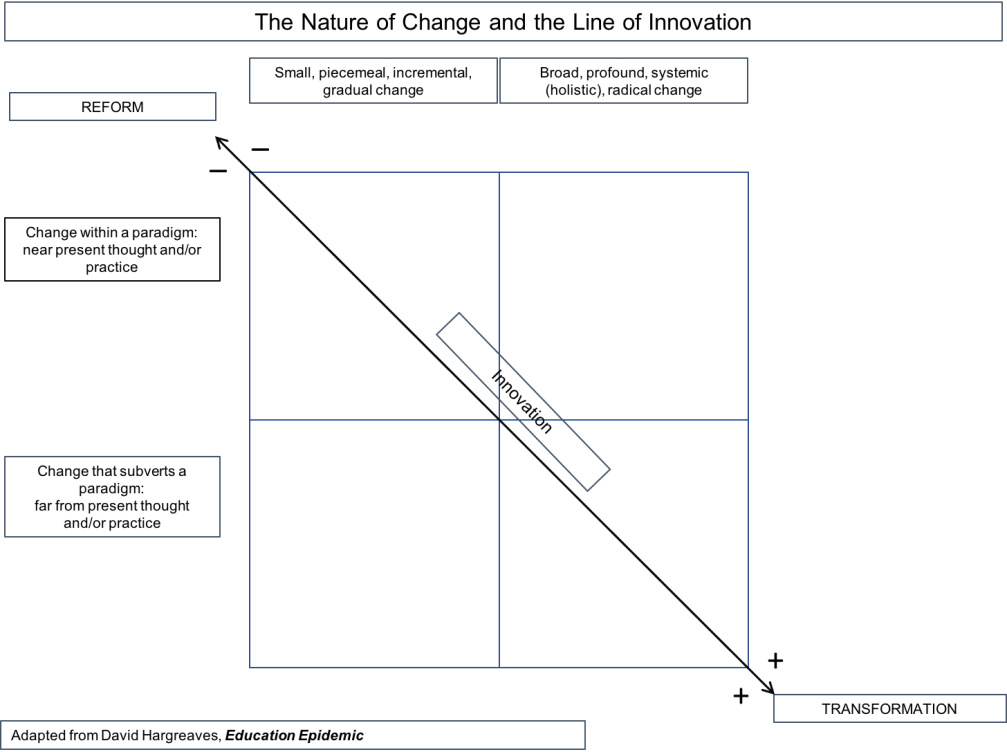
In the first case we usually have small, piecemeal, incremental, gradual changes — surface improvements of an established paradigm. The changes or improvements do not question the paradigm: they take it for granted. When they have to deal with practice (and not theory), these changes and improvements do not depart too much from the conventional, almost universally accepted, way of doing things.

In the second case we usually have to deal with broad, profound, systemic (holistic), radical, often abrupt changes, that lead to the destruction of an established paradigm and its replacement by another. The changes here subvert the established paradigm, since they aim at replacing it by another paradigm. When they have to deal with practice (and not theory), these changes significantly depart from the conventional, generally accepted, way of doing things.

If we extend a bit further the use of a political analogy, we could say that the first kind of change is reformative, while the second is transformative. Reformative change is “change within the paradigm”. Transformative change is “change of the paradigm”. Transformative change is very close to, if not the same thing as, revolutionary change. It is also very close to, if not the same thing as, recreating or reinventing that which is the object of change.

The main indicator that helps us differentiate between the transformative and the reformative nature of a proposed change is the degree of innovation that it represents in relation to what presently is thought or done. Innovation has to do with what is new. Its degree can be measured by comparing what is new in thought or practice with present thought or practice. The greater the degree of innovation, the greater the departure from present thought or practice and so the greater the breadth, depth, all-inclusiveness, and radicality of the change.

The following figure, taken from a small book by David Hargreaves called Education Epidemic, available for free on the Internet, helps understand what is being said here.

Change and innovation

3. The School: Reformation or Transformation?

The graphic shows that the two kinds of change mentioned can lead to:

  • Institutional or organizational reformation: when the change takes place within existing structures and maintains the present paradigm;
  • Institutional or organizational transformation: when the change goes beyond existing structures and replaces the present paradigm (to transform is to go beyond [trans] present form, to transcend existing structure, to replace the paradigm).

Something else that is important is the following. If, in a process of change, we concede too much to existing thought and practice, innovation will be the first victim: there will be little that is new and the end result will not be very different from where we started.

Three quotes, coming from widely different sources, corroborate this assertion:

“The only way to drastically change the world is to imagine it different from the way it is today.  Apply too much of the wisdom and knowledge that got us here, and you end up right where you started. If you want to get different results, take a fresh look from a new perspective” (Jay Allard, former Microsoft Vice-President – quote slightly altered for emphasis; bold and underlining added).

“If you keep doing pretty much what you’ve always done, you’ll keep on getting pretty much what you’ve always got” (Jack Canfield, well-known author – quote slightly altered for emphasis).

Insanity is doing the same thing over and over again and expecting different results” (attributed to many people, including Benjamin Franklin and Albert Einstein).

As already mentioned, the last sixty years brought about change in the world that was broad, profound, systemic (holistic), radical, often abrupt, and frequently unexpected. This change led to significant departures from existing thought and practice in almost every area of life – enough to cause many important authors to speak of a new Renaissance, a new era, a new civilization. It is difficult to imagine that this sort of change would leave an important institution of society, such as the school, unaffected.

And yet, as mentioned in the previous section, the school was, and continues to be, a notable exception among the institutions that the twentieth century inherited from the previous centuries. While it is undeniable that there have been small changes and innovations within the school in the past two hundred and fifty years or so, they are mostly superficial or cosmetical, and very often affect only one single dimension of the institution: either the curriculum, or the methodology, or the form of assessment, or the kind of technology used, or the other resources employed, or the style of management, or the relation with the world of work, or the relation with the surrounding community, etc. The institution itself has not been significantly changed. It certainly has not been transformed: the school is still basically the same institution created around two centuries and a half ago at the beginning of the Industrial Civilization.

There seems to be little doubt that the school will become an obsolete institution (assuming it is not there yet) and eventually die if we allow it to rest content with a lesser sort of change that keeps too close to existing thought and practice. But that is what will happen if we limit the degree of innovation that affects it.

So, when we speak of innovation, it is this second kind of change – transformative, revolutionary change – that we must have in mind: it is the reinvention of the school that we must pursue. This is the only attitude compatible with the paradigm proposed in the previous article. And yet this will not take place quickly: it will require persistence and patience.

To create itself anew, and before it can renew its practice, the school must rethink its theoretical framework, that is, its pedagogical vision, which includes its view of education and learning and its understanding of its own role in the learning of the students.

4. The School of the Industrial Civilization

The school that we know was created in the Industrial Civilization according to the model that prevailed in the factory. These are the main elements of this model:

  • First, you define the core function of the factory: in the case of the school, the delivery to the new generations of the cultural legacy of the past;
  • Second, you define and organize the processes: in the case of the school, you organize the legacy in compartments (disciplines) and divide it up in dosages adequate to the imagined capacity of those to whom it is going to be delivered (grades);
  • Third, you define a methodology, namely, the way in which this legacy ought to be delivered to the students: disciplinary teaching to groups of no more than forty students for several periods of no more than fifty minutes with small intervals (five to ten minutes) between them;
  • Fourth, you define the professionals you need to deliver the legacy through teaching: specialists in the content of the disciplines (which, if too complex, may require a specialist for the earlier years and another for the more advanced years);
  • Fifth, you define methods of quality control: regular assessments in the form of quizzes, tests, examinations that guarantee that everyone, in a given age group, knows basically the same about any given discipline;
  • Sixth, you define other norms that guarantee that the students attentively receive the delivery in orderly and disciplined regiments, that they do not talk or consult with each other especially during assessments, and that make it difficult, if not impossible, for any student to claim or receive individualized attention or personalized treatment.
  • Seventh, you define what should be the standard profile of the student as he finishes his schooling and final examinations that should guarantee that all graduating students conform to this profile

5. The School in the Learning Society

In the present stage we do not as yet have a Learning Society: a society in which all institutions have an educational focus and contribute to the learning of those that participate in them.

But we must create a new school that performs a transitional role in helping create the Learning Society and in preparing us to actively, interactively and collaboratively learn in it.

In the next article its contours will be discussed.

São Paulo, on the 12th of October, 2012, revised in São Paulo, on the 22nd of August, 2017

(*) I thank Microsoft’s Brazilian subsidiary for the authorization to use in this article material that I wrote at her request five years ago.

1 – Looking Anew at Education (*)

Many animals instinctively rear their children – but only humans educate them in a conscious, deliberate, intentional way.

Looking anew at education could mean simply looking once more at it, but in the same manner, as something that has always been with us. But it can also mean looking again at it, but this time, in a fresh and innovative manner. That is the sense in which the expression “looking anew” is intended in this article.

Education does not take place in a vacuum. It always takes place in a specific context: a given place, a given time, for given reasons and with given resources. When this context changes drastically, we must look again at education in a fresh and innovative manner: as a matter of fact, we need a paradigm shift.

There is no doubt that the in the last seventy years (from 1945 up to now) the context in which education takes place underwent profound changes. The emergence of digital information and communication technologies (digital ICT) radically transformed this context. Until World War II the context was one in which information, communication, and therefore knowledge were scarce, and access to them was difficult. Now the context is one in which information, communication, and therefore knowledge (knowledge that and knowledge how) are abundant, and access to them is easy, at our fingertips, anywhere, anytime – often instantaneously.

Given this radical change of context (and only one aspect of it was focused), education cannot, and will not, remain unaffected today. We need to change how we conceive it and how we implement it.

1) Understanding Education

Any person or institution interested in education must have, if not a precise definition of what it is, at least a clear and definite understanding of the concept.

Education, in the recent past, basically meant transmission or delivery of information and knowledge. Education, in this context, was generally organized (in the form of schools involving teachers, curricula, methodology, evaluation, etc.) to implement this understanding.

This understanding of education made sense in a context where information and knowledge were scarce and access to them was difficult. That context no longer exists. Thus we must look for a different understanding of education. We could try to invent, out of nothing, a totally new concept. Or we could recapture insights that, in bits and pieces, have already been with us, sometimes for a long time, but never found real resonance and never were brought together in a unified and coherent concept. That is what will be done here.

Take, for instance, this quote from Jean-Jacques Rousseau’s Émile (published in 1762), that is, perhaps, the most important essay on education written in the 18th century, before industrial civilization became widespread:

“All that we lack at birth, and need when grown up, is given us by education”.

This statement feels refreshing today because it emphasizes an important thing, often neglected in our times: everything (“all”) that we need in order to live our life, and that is not innate to us (“that we lack at birth”), must be acquired through education.

Translated into more contemporary language, this means that education has to do, not with the transmission and delivery of information and knowledge, but with the very process of human development.

Development is not the same thing as growth. Development is the product of learning. Someone can grow and not develop as a human being. Mowgli, the boy in Rudyard Kipling’s jungle stories, grew up, but did not develop as a human being. If we can speak of development in his case, it is more in terms of wolf development than of human development.

Rousseau reminds us that education is not limited to our intellectual development. Education involves also other dimensions of human life: psychomotor, social (interpersonal), affective (emotional), aesthetic (sensible), ethical and perhaps even spiritual. This is what is meant today by the expression “human development”. To add “full “or “integral” to this expression is almost pleonastic.

Even though Rousseau does not say it in this passage, the things that are innate to us (whatever they may be) can be exercised, extended, improved, perfected through education — in all of the dimensions specified.

This means that we considerably impoverish education if we conceive it only (or even primarily) as intellectual development, even if we add the mastery of skills and competencies to the absorption and assimilation of information and knowledge.

Education is still more impoverished if we see it primarily as preparation for the job market in the digital economy or for effective citizenship in a democratic society, even though education as human development may include both of these things. But it includes much more, such as, for instance, the development of characteristics that culminate in one’s self-realization — what the Greeks called eudaimonia. Achieving eudaimonia implies defining, choosing and actualizing one’s life project.

2) Formal, Non-formal and Ubiquitous Education

Human development, thus conceived, begins, it goes without saying, at birth – and ends, most likely, only at death.

In an important article written in 2010, Ecuadorean educator Rosa Maria Torres welcomes UNESCO’s recognition that education (that she correctly considers synonymous with learning, not with teaching) is a lifelong process that begins at birth and ends only at death (“Lifelong Learning: Moving Beyond Education for All”, International Forum on Lifelong Education, Shanghai, China, May 19-21, 2010).

Her text shows that, by changing the theme from “Education for All” (that really meant schooling for all) to “Lifelong Education”, UNESCO changed the challenge that government educational policy and private educational programs around the world must face. In this case, the distinction between formal and non-formal education loses importance, since education is no longer synonymous with schooling and teaching, and learning takes place both in formal (school-like) and non-formal contexts. Concern with education must begin much earlier than regular schooling and involve the whole life of the person in its multiple dimensions. Education becomes an “anytime, anywhere endeavor” that lasts throughout one’s life. In other words, education becomes ubiquitous. Something ubiquitous is everywhere at the same time, i.e., is anywhere, anytime.

3) Society as the Learning Environment

Discussing the concept of education among the ancient Greeks and Romans, James L. Jarrett states, in his magnificent The Humanities and Humanistic Education (p.11):

“Indeed, neither Greek nor Roman was in the least likely to share the modern confusion that identifies education with schooling. We are shaped and formed by the totality of our environment: it follows that we cannot afford to be careless about any aspect of that environment — architectural, legal, ceremonial, erotic, whatever“.

If education has to do with human development in all of its dimensions, and if it takes place throughout the life of the individual, it cannot be accommodated within the confines of a single (and often one-dimensional) institution, namely, the school, without losing its essential ubiquitousness.

Thus, when UNESCO tries, if not to obliterate the distinction between formal and non-formal education, at least to reduce its present importance, it is taking us back to a view already espoused by the ancient Greeks and Romans.

But the point of view defended by the ancient Greeks and Romans went beyond giving equal attention to formal and non-formal educational initiatives. They did not favor the schooling of society: they favored making society as a whole the environment in which we learn and thus educate ourselves. According to this view, to be concerned with education is not equivalent to creating and maintaining a good school system (public or private, makes no difference), much less to extending the time people remain in school (freely or under compulsion). Instead of proposing that the school should become a totalitarian institution in society, the ancient Greeks and Romans proposed that all the institutions and activities of society have an educational focus — that is, that society should become a truly educational (i.e., learning-centered) environment.

The richness of this  idea is mind-boggling. The ancient Greeks and Romans were not contemplating the educational role of only a few institutions of society, such as the family, the church, the local community, the communication means, industrial and commercial enterprises, cultural and leisure-focused organizations — not even of the school. They meant that every institution and every activity of society, from the way cities are planned and built, passing through how they are organized and governed (including, necessarily, their laws) and through how they are maintained by means of free economic activities, and arriving at how leisure is promoted and organized, that all of this be learning-focused – that is, be educational.

Rather than proposing a totalitarian schooling of society, they proposed the total deschooling of society (à la Ivan Illich), because learning should become society’s overall focus and concern. If the ancient Greeks and Romans had known the present digital information and communication technologies, they would probably have emphasized their point much more strongly and realistically.

4) How Learning and Education Take Place

Paulo Freire, Brazil’s best known educator, said in his book Pedagogy of the Oppressed the following (here in a somehow free translation that joins ideas found in more than one place):

“Nobody educates anybody, but nobody educates himself either. We educate each other through a continuous dialogue, mediated by the world, in which we use resources that, in traditional education, are owned only by the teacher. Education therefore is a mutual, world-mediated process in which unfinished beings, conscious of their incompletion, attempt to be more fully human”.

5) Our Role in Education

What do these reflections, that mix the thought of the ancient Greeks and Romans with the thought of a leading Enlightenment figure and of a 20th-century Brazilian educator, have to say to us, who live in the 21st-century? What does it have to say  to governments, private companies, non-governmental organizations, etc., in fine, to anyone concerned with making a contribution to education, and thus to the betterment, of society?

First, we would do well to set our view, in education, way beyond traditional targets such as digitalizing present curricular content so it can be delivered through digital channels, or preparing present teachers to use digital tools to better deliver content that is in digital format. If we confine ourselves within these traditional limits, we deny ourselves the alternative of following the suggestion of the ancient Greeks and Romans that the whole of society be educational – the learning environment par excellance in which human development takes place.

Second, we would do well to stop viewing our target audience as being only either students or teachers (that is, school-bound people). Our target audience clearly includes present students and teachers, as long as they exist as such, but also, as a matter of fact, everyone engaged in the educational task of, through dialogue, overcoming their unfinished, incomplete condition and becoming more fully human. And we ought to become fully aware that educational work is done in the world, not necessarily in schools.

Third, Bill Gates, in one of his books, underlined an important contribution technology companies can make to the digital economy. However, in line with what I just said, he might as well be underlining the main contribution technology companies can make to education, conceived along the lines here described. Here is what he said:

“Digital tools magnify the abilities that make us unique in the world: the ability to think, the ability to articulate our thoughts, the ability to work together to act on those thoughts.  I strongly believe that if companies empower their employees to solve problems and give them potent tools to do this with, they will always be amazed at how much creativity and initiative will blossom forth” (Bill Gates, with Collins Hemingway, Business @ the Speed of Thought – Using a Digital Nervous System, 1999, p. 415, last paragraph of the book).

If we apply this reasoning to education, we will stop thinking only of companies and their employees and start thinking of society and everyone that inhabits it…  “Digital tools magnify the abilities that make us unique in the world: the ability to think, the ability to articulate our thoughts, the ability to work together to act on those thoughts”. If society empowers its members to solve problems and gives them potent tools to do this with, we will all be amazed at how much creativity, initiative and genuine learning will blossom forth.

If the analysis here made makes sense, then it makes no sense to think of technology companies as entities that do not need (or even ought not) to have a stand on substantive educational issues, since they (as some have argued) cannot get involved with the “pedagogical black box” with which only professional educators would be authorized to deal. In what is here proposed, technology companies become a very important part of the overall educational environment that is our society, and, even if we do not take into account their philanthropic and/or corporate social responsibility activities, their products and services still are part of the educational (i.e., learning-centered) environment which society makes available to its members.

It is clear, therefore, that technology companies would be contributing their due share to our society as its corporate citizens even if they only (as if this were little!) continued to offer to society quality digital tools and services that help bring forth the required creativity, ingenuity and initiative that will help us solve many of our problems. (See Jean-François Rischard, High Noon).

Fourth, the initiatives in the area of formal (school-focused) education and in the area of community affairs, supporting programs and organizations that work with digital inclusion and non-formal education, that most of the main technology companies have taken, are also part of their educational effort, if education is understood in the broader perspective that is suggested here.

Fifth, in the broader perspective that is suggested here, the description that Microsoft, one of the major technology companies of our time, used to make of its “core mission” as a “corporate citizen” of our society is not mere rhetoric: “to help people and businesses around the world realize their full potential”. Realizing one’s full potential is equivalent, in the case of individuals, to achieving self-realization — which is the goal of human development, that is, of education.

But this is a general statement. We are specific individuals, each one with their own interests and passions, gifts and talents, levels of ambition, motivation and energy. The central initial focus of education must be the definition and choice of one’s life project. After that comes the effort to transform that project into reality. In this process, monitoring and evaluation are invaluable to show the need of small course corrections or, eventually, of drastic revisions in the plan of action.

Education, it can be summarized, is equivalent to the strategic planning of one’s life and to the execution of this strategic plan. We do not do it alone: we do it collaboratively.

São Paulo, on the 7th of October, 2012, revised in São Paulo, on the 22nd of August, 2017

(*) I thank Microsoft’s Brazilian subsidiary for the authorization to use in this article material that I wrote at her request five years ago.

Deschool Education or Change/Innovate/ Transform/Reinvent the School?

The main objective of this blog is to show that we can promote and drastically improve education by creating a learning society in which schools play no role (except, perhaps, that of temporary custodians of people who have no other place to be).

An enormous effort and a fantastic amount of money are dedicated nowadays to attempts to promote and improve education by changing / innovating / transforming / reinventing schools. The results are dismal.

This blog will propose a different route – which is not in any way new.

In 1970 Ivan Illich wrote his path-breaking book Deschooling Society. At that time the information and communication technologies (ICT) we have today still did not exist. And yet Illich proposed something very similar to what his friend Paulo Freire was demanding, more or less at the same time, in Pedagogy of the Oppressed: that we educate one another through interaction, dialogue, collaboration, personal exchanges – without any need of schools and professional educators.

Today we have fantastic ICT that allow us easy access to the Internet’s universal library and, more important, that allow us easy access to one another, to people with sophisticated competencies, knowledge and expertise that, incredible as it may seem, are often quite willing to communicate with others, on a one-to-one basis or in more general environments, to share what they know and know how to do, in order to help them learn what they are interested in learning, want or need to learn.

It is now possible, through the many social networks and media, to bring the maieutic learning methodology proposed by Socrates to scale, offering everyone a personalized education that satisfies their interests, wants and needs.

In times past (and present) we worried about teaching methodologiesdidactics. It is now more than time that we move on to worry about learning methodologiesmathetics, an idea from Jan Comenius that Seymour Papert more recently relaunched and amplified (and Papert was a good friend of Freire and Illich as well).

In 1983 I wrote an article questioning those who viewed ICT as ways to automate  teaching through teaching machines and programmed instruction and proposed instead that we view ICT as tools to enable and facilitate human learning. At about the same time Bill Gates, in his first book (Business @ the Speed of Thought), insisted that the revolutionary potential of ICT in Education was in that they put people in contact with people, and gave them access to information so they could do whatever they wanted or needed to do to promote their interests and transform them into reality.

To learn, as Peter Senge showed in The Fifth Discipline, is not to accumulate information (to become “mentally obese” with information, as Rubem Alves said, in more than one place): to learn is to become capable of doing that which we could not do before (and, often, wanted to do). As simple as that. To learn is to build capacity (capacity building). To learn is to develop competencies (competency development). To learn is to gradually make of ourselves fully sculpted or sculptured human beings, to make ourselves that which we want to become, to define a life project for ourselves and to effectively act to make it a reality.

Differently from many other animal species, we are born not knowing much and not knowing how to do almost anything. We are born “inautonomous” (not to say incompetent), unable to take care of ourselves. That is why we have to depend on others for quite some time – until we start learning things and, most importantly, until we start learning how to do things. We take about one year to start walking, two to three years to start communicating verbally in a minimally effective manner… Some kids (?) in our society require about 25 to 30 years to find out what they want to make of themselves and to become financially (and otherwise) autonomous in the care of themselves.

Toddlers

Fortunately we are born with three characteristics that are essential to human development:

a) our genetic programming is minimal and open: within limits, we can become almost anything we want;

b) our innate capacity for learning (in the sense seen above) is incredibly large, flexible, and quite effective;

c) otherwise we have quite different individual features from one another added to our basic common human substratum.

Given these features, mass education, education of the type “one size fits all”, should be abandoned. Personalized education is imperative. And, today, we all can achieve it, with the help of already available formidable technologies. Today we can bring socratic maieutic to scale so it can benefit everyone.

So, the time is ripe to deschool and personalize education and to make ours truly a learning society.

São Paulo, on the 22nd of August, 2017

What I Now Think about Education

It took me several long years to convince myself of the truth of several theses that I find extremely important today:

(01) That education has to do with learning (not with teaching);

(02) That what happens to children in schools, as a result of teaching, is not learning, being, in the best possible case, nothing more than information absorption and assimilation — which may be important, in certain contexts, but otherwise make people “mentally obese” (Rubem Alves), and certainly is not education;

(03) That learning, as such, has to do with capacity building and competency development, that is: to learn is to become capable of doing things which one was not capable of doing before;

(04) That important, relevant and “significative” (meaningful) learning takes place through active observation, emulation, interaction, dialogue, collaboration, mediation, etc. in the context of projects that challenge children (or any other would-be learners) to solve problems related to their interests and concerns in the process of living their lives in the real world;

(05) That this kind of learning is more impeded than promoted in artificial ghetto-like environments such as schools, even if these environments are effective in achieving the conventional objectives schools normally seek to promote, and even if they are reduced in scale to operate in one’s own home, but try to replicate the schools that exist outside, as most home schooling initiatives do;

(06) That what we need today is a radical unschooling (in the line of Ivan Illich’s “deschooling society”) that definitively breaks the factual link that exists today between education and schools (a conceptual or necessary link never having existed);

(07) That home education (provided it does not emulate what goes on in schools in terms of its goals, contents, methods, approach to evaluation, etc.) is clearly part of the solution, since the home certainly must become again a meaningful and coherent educational environment, but is only a portion (though a significant one) of the large-scale solution that is presently required;

(08) That home education must be complemented by educational efforts by the extended family, the community (neighborhood), the church, the club, all the other places of leisure and play, the places of work, the social networks, the media, etc. — in one idea, by the society at large, that must become a learning society – without any overall effort at coordination by governments or the like;

(09) That the fundamental content of this education is basically contained, as far as cognitive (or hard, or basic) competencies are concerned, in the Medieval Trivium (the first three Liberal Arts: Language, Logic and Rhetoric), and, as far as the so-called non-cognitive (or soft, or 21st-century) skills, in Stephen Covey’s 7 Habits of Very Effective People;

(10) That the mastery of numerical, geometrical, symbolical, scientific and artistic competencies (that make up the Medieval Quadrivium) can be gradually inserted, in a personalized manner, into the education of learners that demonstrate interest and aptitude in these fields and to the extent that their passion and talent permit.

(c) Eduardo CHAVES, 2017

In Ubatuba (SP/BR), on the 9th of July of 2017

Postscriptum of June 16th, 2018:

I wrote this Decalogue one year ago, in June 2017, while I prepared a paper for the PBL-2018 Conference on Problem-Based Learning and Other Active Methodologies, which received the title “Reinventing the School or Deschooling Education?” (The Conference took place in February 2018 in Santa Clara, CA, in the campus of the Santa Clara University).

Although I wrote this Decalogue only one year ago, the ideas that came into it had been taking shape for well over 50 years, ever since I started High School in 1961 in a boarding school in Brazil, the Institute José Manuel da Conceição, located in a small community in Jandira, SP, in the neighbourhood of São Paulo. These ideas were fairly well completed, in a coherent educational outlook, by the time I was President of the Lumiar Institute, responsible for the Lumiar Schools, during 2007-2009.

I originally shared this Decalogue in my blog “EduTec Space” (https://edutec.space) on the 9th of July of 2017. I share it again, in the same blog and in a different blog (“Chaves Space”, https://chaves.space), for the benefit (I hope) of those who didn’t read it then.

EC